More Than a Sports Physical: MetroHealth's Summer Clinics Connect Students to Lifesaving Care
Published on 09/16/2026
At John Hay High School this summer, healthcare looked a little different.
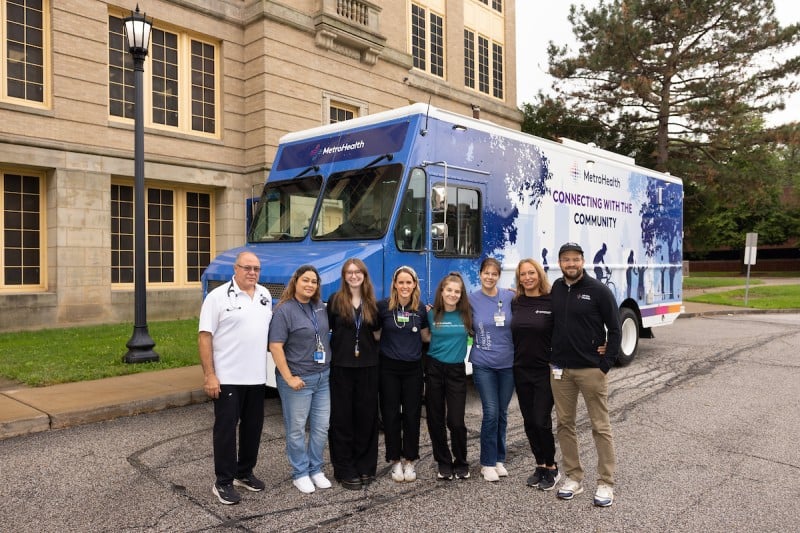
Nurses set up stations beside school lockers. Physicals took place on the auditorium stage. Blood draws were performed in temporary spaces on the auditorium floor while MetroHealth's mobile medical unit stood ready in the parking lot.
Those improvised clinics helped 72 students at John Hay alone complete physicals, but the real impact extended far beyond sports clearance forms. Each visit created a connection to ongoing care, allowing MetroHealth's School Health Program to identify health concerns, address unmet needs and establish relationships that will continue long after summer ends.
For many students, a sports physical is more than a requirement for participation. It can be the first step toward reconnecting with healthcare.
This summer, donor support helped MetroHealth's School Health Program reach students in new ways. Through an innovative traveling pop-up clinic model, healthcare teams brought well-child visits, sports physicals, vaccinations and preventive care directly into Cleveland Metropolitan School District (CMSD) schools, helping students access the care they need to stay healthy, engaged and ready to succeed throughout the school year.
School Health Program clinicians, in partnership with the CMSD Athletic Department, transformed several high schools into temporary healthcare hubs during the summer months. By setting up clinics in schools that do not currently host School-Based Health Centers, the team expanded access to essential healthcare services for students across the district.
The goal is simple: remove barriers and make care more convenient for families as they navigate the school year. Students could receive well-child checks, sports physicals, vaccinations, laboratory services and other primary and preventive care in a familiar setting close to home. For many families, the model eliminated challenges that can delay care, including transportation difficulties, scheduling conflicts and long waits for appointments.
"The feedback has been very positive," said Josh McLaughlin, Director of MetroHealth's School Health Program. "Families appreciate that we are making care convenient, making it accessible and coming directly to the school site."
According to John Yousef, APRN-CNP, many of the students arriving at the summer clinics had been disconnected from healthcare for extended periods.
"For some students, this is the first wellness visit they've had in two years," John said. "We're finding students with chronic conditions like asthma who don't even have access to an inhaler."
John noted that sports physicals often serve as the first step toward ongoing healthcare. Once students complete their physicals, they can be enrolled in the School Health Program and connected to annual wellness visits and other services throughout the school year.
Those discoveries illustrate why the clinics are about much more than sports participation. What begins as a routine physical can uncover health concerns that might otherwise go unnoticed.
That was the case for one student seen this summer by Katie Edwards, APRN-CNP, at the James Ford Rhodes High School clinic.
The student came in hoping to play tackle football and needed a routine sports physical. During the visit, she mentioned experiencing unusual fatigue. Katie listened carefully and ordered additional testing.
The results revealed dangerously low platelet levels, placing the student at significant risk for serious injury and internal bleeding, particularly while participating in sports. The School Health Program team quickly connected her with Hematology specialists. She was admitted to the hospital, where she received IVIG (intravenous immunoglobulin) therapy to treat her low platelet count, along with additional care and evaluation.
"What seemed like a routine sports physical turned into something much more serious," Katie said. "That's why these visits matter."
The student's family had recently moved to Cleveland from Akron and was struggling to navigate challenges. A lack of transportation made accessing appointments even more difficult. MetroHealth Community Health Workers stepped in to coordinate rides and help the family receive ongoing care.
The student's mother was deeply grateful.
"Usually we're getting kids cleared to play sports," Katie said. "But sometimes taking the time to listen uncovers underlying health conditions that could have devastating consequences if they go untreated."
For Katie, who has spent 13 years practicing family medicine, the experience highlights what she has come to love about community-based care.
"I've developed a newfound passion for meeting patients where they are," she said. "It's different from traditional medicine. Being in the community allows us to build relationships and reach families who might not otherwise get care."
The response to the summer clinic program exceeded expectations. In June alone, the School Health Program surpassed the combined June and July activity levels from the previous two years. Momentum continued through July, with visits increasing significantly compared with both 2024 and 2025.
For Josh, the early results suggest the pop-up clinic model may offer a promising solution to a longstanding challenge: ensuring children and families remain connected to care when traditional school-based clinics close for the summer.
The initiative grew out of the creativity and dedication of the School Health Program team. Registered nurse coordinators Kelly Blevins, Emily Agostino and Betsy Martinez first identified the opportunity to bring care directly into schools during the summer months. The broader School Health Program team then worked quickly to make the concept a reality, adapting to unfamiliar school buildings, changing schedules and a compressed planning timeline to serve families where they needed care most.
The summer outreach effort builds on more than a decade of impact through MetroHealth's School Health Program. Since 2013, the program has broken down barriers to healthcare by bringing services directly into schools where children spend most of their day. What began as a single clinic in a converted classroom has grown into a comprehensive program serving more than 6,200 students annually across nearly 30 schools in five districts. Students participating in the program are more likely to stay current on preventive care and immunizations and less likely to require emergency care for preventable conditions.
The clinics also helped students stay on track for athletic participation. Families took advantage of the opportunity to bring siblings and other children to clinic sites, extending the program's reach beyond athletics and strengthening connections to primary care across entire households.
The success of the initiative was strengthened through collaboration with school-based health partners across Ohio. As part of the Ohio Department of Health's School-Based Health Center grant cohort and the Ohio School-Based Health Alliance, MetroHealth regularly shares ideas and best practices with peer organizations. Conversations about effective summer outreach strategies helped inform MetroHealth's approach, demonstrating how collaboration can accelerate innovation and expand access to care for students and families.
Partners such as Teresa Fletcher, APRN-CNP, Coordinator of Akron Children's Hospital School-Based Health Center Program, have helped foster a spirit of collaboration that allows programs across the state to learn from one another and expand access to care for students and families.
At its core, the program reflects a belief that every child should have access to quality healthcare, regardless of circumstances. By meeting students where they are, MetroHealth clinicians are identifying health concerns before they become crises while supporting academic success, athletic participation and overall well-being.
"Healthcare doesn't stop in the summer just because kids are playing and not in school," said Katie Davis Bellamy, MSN, RN, PHNA-BC, Chief Operating Officer of MetroHealth Community Health Centers. "Whether that's on our mobile unit, whether that's in one of our in-school clinics or at one of our brick-and-mortar sites, we want to be there for families and help connect them to the right place to get care at the right time."
As the school year gets underway, the impact of MetroHealth's summer clinics is already being felt. Students who may have otherwise gone without preventive care are now connected to providers, managing chronic conditions and better prepared to succeed in the classroom and on the playing field.
Thanks to the generosity of donors, MetroHealth can continue developing innovative ways to reach children and families, strengthening healthy futures across our community one visit, one relationship and one school at a time.
"That's how you build relationships and trust," Katie said. "It's showing up."
To support the School Health Program, contact Greg Sanders, Vice President of Philanthropy, at gsanders@metrohealth.org or 440‑592‑1319.
Your Generosity Means a Healthier Greater Cleveland
Support MetroHealth in its commitment to care for all.