Giant Eagle
Using Food as a Pathway to Health and Healing
Published on 11/17/2026
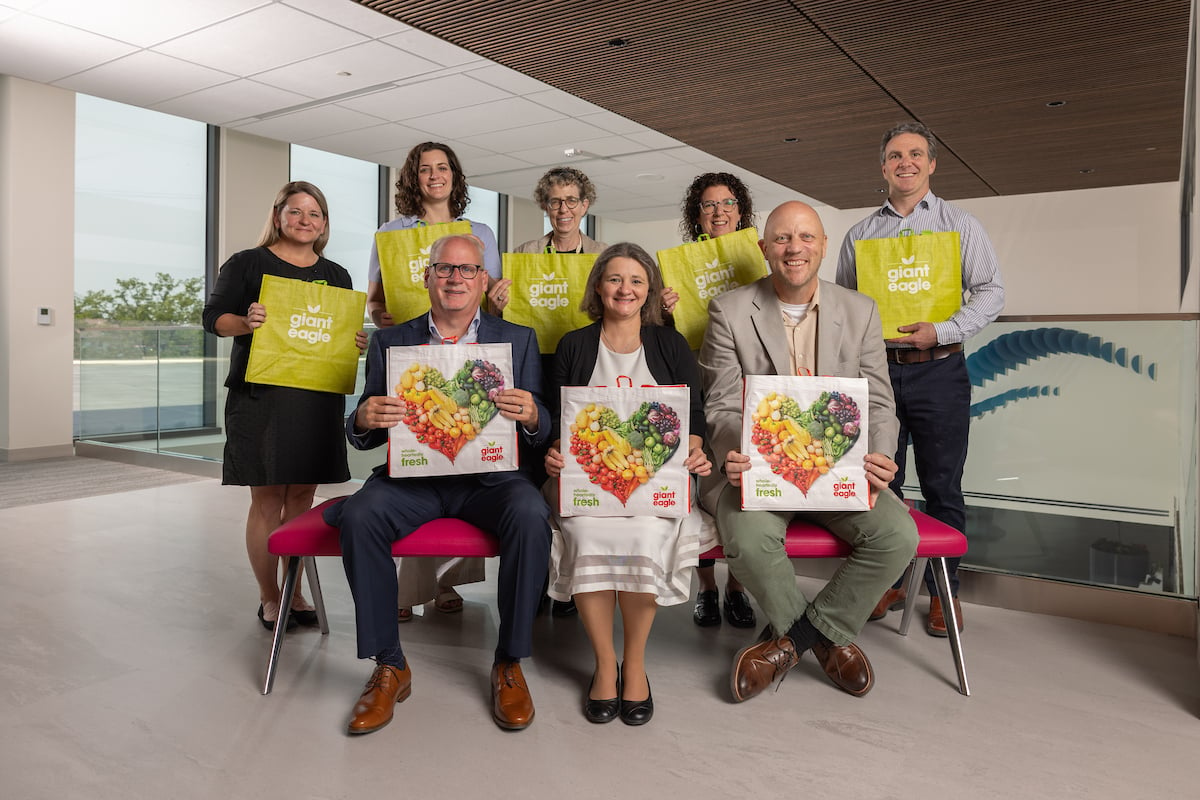
Pat Scullin, Regional Vice President, Giant Eagle, Inc.; Melinda Gaus, Specialist Lead, Community Partnerships, Giant Eagle, Inc.; and Greg Sanders, Vice President of Philanthropy, The MetroHealth Foundation. Back row, from left: Kellie Mayle, Philanthropy Officer, The MetroHealth Foundation; Kristen Matlack, MPH, Manager, Social Care Initiatives, Institute for H.O.P.E.™; Abbie Sender, Philanthropy Officer, The MetroHealth Foundation; Karen Cook, Executive Director, Social & Community Health, Institute for H.O.P.E.™; and James Sulzer, PhD, Staff Scientist and Associate Professor, MetroHealth Rehabilitation Institute.
Recovery doesn’t end when a patient leaves MetroHealth. Whether someone is learning to manage a chronic health condition, access healthy food or regain independence after a serious injury, healing often depends on support that extends into everyday life.
That’s why Giant Eagle has partnered with MetroHealth for more than 25 years. From medically tailored meals and community food access programs to innovative rehabilitation initiatives, the company helps connect patients with the resources they need to improve their health, recovery and quality of life.
Medically Tailored Meals
For patients living with chronic conditions, healthy eating is often an essential part of treatment. Through MetroHealth’s Medically Tailored Meals pilot, developed in partnership with the Greater Cleveland Food Bank, participants receive meals specifically designed to support conditions such as diabetes and hypertension.
Specially prepared meals tailored to participants’ medical and cultural needs are delivered directly to their homes by the Food Bank. Each participant receives 10 meals per week for six months, helping to improve food security and remove barriers to healthy eating while supporting disease management.
Providing medically tailored meals and home delivery over six months requires a significant investment, making the pilot one of MetroHealth’s most costly food insecurity initiatives.
“Support from Giant Eagle is critical because there is no sustainable funding source for this work,” said Kristen Matlack, Manager of Social Care Initiatives at MetroHealth’s Institute for H.O.P.E.™
Bringing Healthy Food Closer to Home
The Institute for H.O.P.E., in partnership with the Greater Cleveland Food Bank, operates monthly Mobile Pantries at three MetroHealth locations, providing fresh produce to community members experiencing food insecurity.
Giant Eagle helps make distributions easier for patients by providing reusable shopping bags. The company donated 6,900 bags, giving participants a practical way to transport the 20 to 30 pounds of produce they often receive.
“Boxes are heavy, and they can be difficult for people to carry,” said Karen Cook, MPH, Executive Director of Social and Community Health at MetroHealth’s Institute for H.O.P.E. “The bags are durable, and their wide handles make them easier for patients to use.”
In the first half of 2026 alone, the Mobile Pantry program distributed 2,500 produce packages, helping provide more than 60,000 meals to local families.
Healing Through Everyday Activities
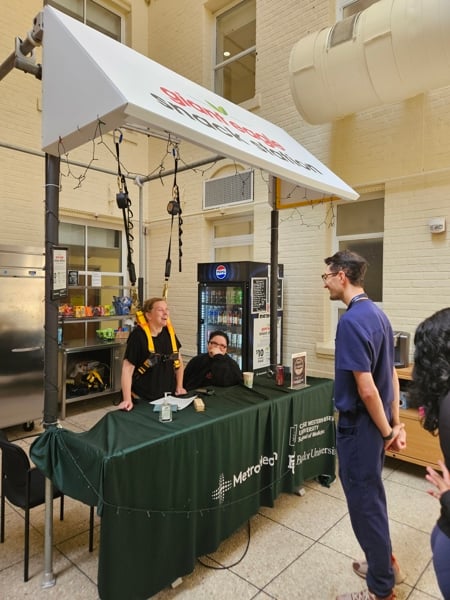
The Giant Eagle-supported Snack Station gives people recovering from traumatic brain injuries an opportunity to build confidence, practice job skills and regain independence in a real-world setting.
Giant Eagle’s support extends beyond nutrition. The company also helps support an innovative research project within MetroHealth’s Department of Physical Medicine and Rehabilitation, funded by the National Institutes of Health.
Through MetroHealth’s Giant Eaglesupported Snack Station, people recovering from moderate and severe traumatic brain injuries rebuild confidence and independence through meaningful, real-world experiences. Participants serve snacks and beverages, interact with customers, and practice decision-making, memory, communication and mobility skills while using a body-weight support harness for safety.
Giant Eagle provides an employee who works alongside the participants, as well as the equipment, signage and inventory needed to operate the fully functioning kiosk.
“The Snack Station is the next stage in therapy,” said James Sulzer, PhD, Staff Scientist and Associate Professor of Physical Medicine and Rehabilitation at MetroHealth and Case Western Reserve University. “Many of the individuals we work with cannot currently be employed because of their disabilities and often spend their time sitting at home.
However, by providing a harness that allows them to safely move and a real-world, motivating and supportive environment to work in, they can prove to themselves and others that they can engage in meaningful work.”
The experience allows participants to practice skills in a dynamic, communityfacing setting rather than a traditional clinical environment.
“The participant is serving the customer. It’s community-facing, and it is teaching them job skills,” Sulzer said. “You have to put people in a situation where it’s not a sterile environment and where they’re doing multiple things at once.”
From addressing food insecurity to helping patients regain independence after injury, Giant Eagle’s partnership with MetroHealth demonstrates how investments in everyday needs can create healthier lives and stronger communities.
Your Impact
To support these programs, contact Greg Sanders, Vice President of Philanthropy, at gsanders@metrohealth.org or 440-592-1319.