Scene Size Up: Treating an Agitated Patient
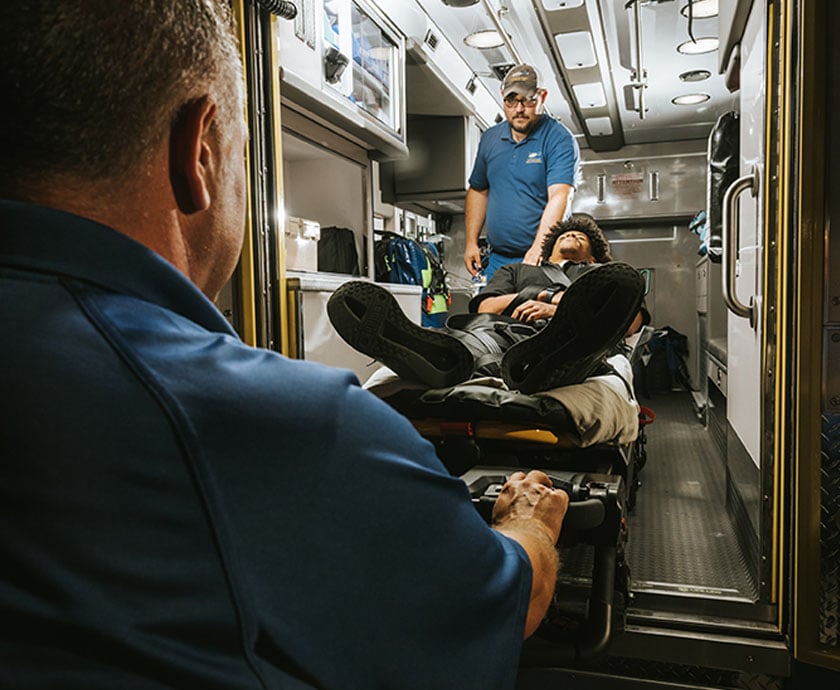
Not all behavioral emergencies are behavioral. Learn to spot life-threatening medical conditions before it's too late.
FieldBrief Issue 4
Your crew is dispatched for an adult male wandering on his neighbor’s lawn and exhibiting combative behavior. When you arrive, it’s 8:08pm and the temperature is 38°F. Officers report that the patient has been pacing, shouting, visibly sweating and refusing to cooperate. He appears confused and repeatedly asks why everyone is trying to hurt him.
Your task: Gather key clinical clues, look beyond first impressions and avoid common cognitive biases to deliver the most appropriate care.
Initial Observations
- Patient appears to be about 40 years old.
- Skin is exposed (patient is shirtless and barefoot) and diaphoretic.
- Speech is hurried and difficult to understand.
- Breathing is rapid.
- Patient shows impaired awareness of his surroundings.
Your first impression is substance intoxication. But is that the whole story?
Scene Assessment
Your task: Before approaching, evaluate scene safety.
- Coordinate with law enforcement.
- Identify potential exits and threats.
- Keep a safe distance between you and the patient.
- Minimize stimulation and the number of people talking to the patient.
- Use a calm, even voice.
- Avoid sudden movements and unnecessary physical contact.
Initial Patient Assessment
Your task: Conduct your primary survey as the patient becomes more agitated.
- Assess airway, breathing, circulation and mental status.
- Treat hyperthermia and altered mental status as red flags that need attention.
- Evaluate for hypoglycemia, hypoxia, infection, toxicologic exposure, trauma and neurologic emergencies.
- Obtain medical history from your only witness, the patient’s sister. She says the patient has bipolar disorder that he usually keeps “under control.”
Differential Diagnosis
Your task: Determine whether the patient's presentation is behavioral, medical, traumatic, toxicologic or multifactorial.
Vital signs:
- Heart rate: 130 beats per minute
- Blood pressure: 222/130 mm Hg
- Respiratory rate: 24 breaths per minute
- SpO₂: 100%
- Temperature: 103.1°F
- Blood glucose: 180 mg/dL
Critical Interventions
Your task: Prepare the patient for safe, secure transport to the Emergency Department.
- Work with police to reassess scene safety.
- Confer with medical control to decide if the patient needs immediate intervention.
- Continue verbal de-escalation.
- Select and administer the most appropriate method of protocol-based sedation while avoiding agents that can worsen the patient’s condition.
- Avoid compromising the patient’s breathing while using the least restrictive restraint method possible.
- Monitor respiratory status, circulation, temperature and mental state.
Avoiding Bias
Your task: Look beyond the behavior. Have you already settled on an initial diagnosis (anchoring bias)? Landed on context clues that support your original assumption (confirmation bias)? Dismissed key medical signs because the patient has a history of psychosis (diagnostic overshadowing)?
- Monitor the patient as agitation decreases, but he remains confused, tachycardic and hypertensive.
- Recognize that reduced agitation does not necessarily indicate clinical improvement.
Transport
Your task: Deliver the patient safely to emergency care. During transport, the patient empties his pockets, revealing old bottles of Keppra, Zyprexa and Norvasc. One bottle contains a crack rock.
- Transport the patient with continuous monitoring.
- Keep the truck cool to prevent additional heat exposure.
- Avoid physical struggles, unnecessary muscle activation, and activities that may generate additional body heat.
- Administer IV fluids (IVF) at room temperature, as directed by the appropriate medical protocol.
- Give the receiving team a comprehensive arrival report, including initial presentation, vital signs, suspected differential diagnoses, interventions and response to treatment.
Review
Your task: Assess your decisions:
- Did you evaluate and treat the patient for potential acute medical/traumatic and psychiatric issues?
- Did you miss any key context clues?
- Did cognitive bias interfere with your decision-making?
Key Takeaways
- Violent or agitated behavior may be a sign of a medical emergency or life-threatening condition.
- The differential diagnosis includes medical, behavioral, traumatic and toxicologic causes.
- When providing protocol-based sedation, avoid medications that may exacerbate the patient's condition.
- Cognitive biases can interfere with patient assessment and medical treatment.
- Look beyond first impressions, challenge assumptions and treat the patient rather than the behavior.
To claim EMS Continuing Education for this edition of FieldBrief, complete a brief survey.
MetroHealth Medical Center is a State of Ohio Approved Continuing Education Site #1202