Listening First, Healing Together: Bethany Monteiro and the Ripple Effect of Recovery
Published on 04/06/2026
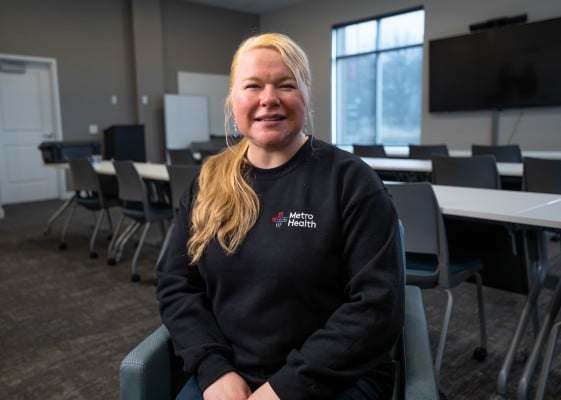
On the first Monday of every month, the front walk of MetroHealth’s Buckeye Health Center turns into a small festival of neighbors and nourishment. Tables fill with fresh produce. People coming for primary care or to pick up a prescription pause to choose peppers and greens, to swap recipes, to talk.
That’s the point, says Bethany Monteiro, Community Outreach Education Coach – to open the door wider.
The produce distribution, which Bethany organized with the Greater Cleveland Food Bank after listening to residents at neighborhood meetings, has become a welcoming threshold, connecting people to resources inside the Opportunity Center and to one another. The idea took root at a “Reconnecting with Community” event she hosted on September 3, 2025 – more than 200 neighbors came – and it’s grown every month since.
Bethany spends Mondays and Fridays at the Buckeye Health Center. On the second Monday evening, she facilitates a virtual peer grief and trauma group; on the fourth Monday midday, she hosts the in-person group right there at the Center. On Fridays, she’s there to be available to the community. It isn’t counseling, she emphasizes; it’s peer support – a safe, stigma-reducing space to be heard, learn and heal together.
“People often say, ‘I don’t feel so alone. I feel heard,’” she says. “Naming what’s happening in the brain and body gives people back a sense of control.”
What Healing Looks Like Here
The Trauma Recovery Center (TRC) serves people whose injuries are tied to victimization – survivors navigating the aftermath of violence and loss. The TRC pairs clinical care with education, advocacy and practical supports. Bethany’s piece is psychoeducation – teaching the science of trauma in plain language – alongside the peer groups she convenes at Buckeye and on Main Campus. For many participants, understanding how trauma affects attention, memory, sleep and stress responses becomes an entry point to healthier choices and next steps.
She begins by validating feelings and thoughts – “thoughts can be like a sixth sense,” she explains – and then guides people toward regulation: noticing what triggers reactions, separating emotions from actions, practicing skills to regain agency. Over time, peers begin reinforcing those skills for one another. It’s not therapy; it’s belonging, language and tools.
Partnership That Builds Trust
Bethany views the KeyBank Foundation’s support of neighborhood-based resources – like the Opportunity Centers – as powerful. “When a financial institution and a healthcare institution show up together to listen, support and give back, you build trust and help heal community trauma,” she says. She also points out something subtle but essential: KeyBank’s support helps fund the environment, a shared space that invites many partners to lead together, without needing to be out front. That kind of trust accelerates collaboration and the impact people feel.
KeyBank’s partnership with MetroHealth helps Opportunity Centers operate as intended: low-barrier, welcoming hubs where someone can get a bag of produce and, in the same visit, learn about a grief group, legal help, benefits enrollment, financial coaching, or job training. It’s a model the KeyBank Foundation has helped expand so more neighbors can access what they need in one place.
About Bethany’s Community Offerings
- Grief & Trauma Peer Support Groups: Open to any adult in Greater Cleveland – you do not need to be a MetroHealth patient. Virtual: 2nd Monday, 6:30–7:30 p.m. In‑person (Buckeye Opportunity Center): 4th Monday, 12:30–1:30 p.m.
- Produce Distribution (Buckeye Opportunity Center): 1st Monday each month, noon-4:00 p.m., in partnership with the Greater Cleveland Food Bank, located at the front entrance to welcome neighbors and connect them with additional resources.
Why Your Support Matters
Supporting the Institute for H.O.P.E.™ strengthens Bethany’s work and the entire wraparound network that turns compassion into measurable outcomes from social‑need screening and closed-loop referrals to community health workers, legal advocacy, food access, arts in health and housing stability. Your gift helps more neighbors move from surviving to thriving.
For more information, please contact Greg Sanders, Vice President of Philanthropy, at 440‑592‑1319 or gsanders@metrohealth.org.
Your Generosity Means a Healthier Greater Cleveland
Support MetroHealth in its commitment to care for all.