From Crisis to Confidence: How Financial Coach Renee Harris Helps Neighbors Build What Lasts
Published on 04/06/2026
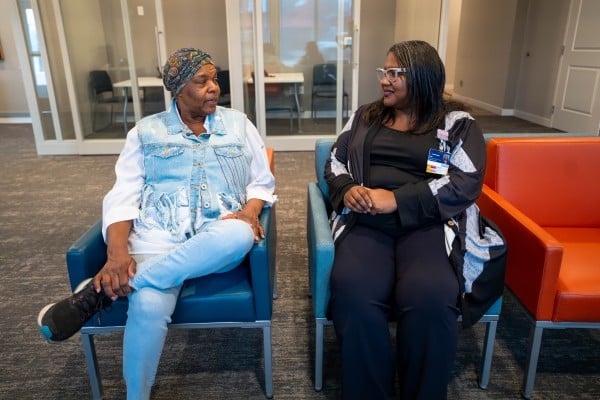
Financial Coach Renee Harris (right) with Darlene Everett
From Crisis to Confidence: How Financial Coach Renee Harris Helps Neighbors Build What Lasts
On a weekday morning at MetroHealth’s Buckeye Opportunity Center, a woman tucks a well-worn binder under her arm and smiles. A few months ago, she wasn’t sure where to begin. Bills arrived late; apps felt confusing; goals were fuzzy. Today, she has a plan – and a partner.
That partner is Renee Harris, a Financial Coach with MetroHealth’s Institute for H.O.P.E.™, who meets people where they are – by phone on a lunch break, over Zoom after a night shift, by text between bus transfers – and walks with them until the next step feels possible.
“Delivery depends on the individual,” Renee said. “Technology lets us truly meet people where they are, so the help is convenient and consistent.”
Renee talks about money in plain language because life is lived that way. “A lot of people don’t know what they don’t know – most of us weren’t taught this in school,” she said. “I’m a single mom. I’ve worried about utilities, childcare and the space between paychecks. The difference is, I know who to call.”
That understanding – competence with compassion – is the foundation of trust she builds with every person she coaches.
What a Financial Coach Really Does
Renee’s title is Economic Opportunity Coach, but she says “financial coach,” so it clicks immediately. She helps neighbors stabilize income, access benefits, budget, build credit safely and connect to job training. These are the practical tools that move a family from surviving to stable. Just as important, she restores calm by being the person you can call when you don’t yet know the answer.
That work is central to MetroHealth’s mission to care for the whole person. Financial strain and social barriers aren’t separate from health – they shape it. Stress over bills and food can cascade into hypertension, poor nutrition and emergency care. The Institute for H.O.P.E.™ was created to tackle these health‑related social needs alongside clinical care, because removing barriers is often the first medicine someone needs.
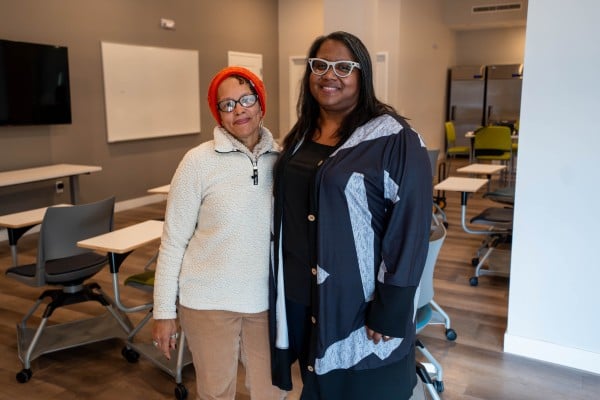
Renee Harris (right) with Linda Hunter
Linda Hunter
When Linda Hunter first connected with Renee, she wasn’t sure she even wanted services; she came in “more curious than committed.” Together, they started small: stabilizing income, paying bills on time and building a financial binder so everything had a place and a plan. Renee also connected Linda with a Digital Navigator to make her smartphone a tool rather than a hurdle. The convenience of back-to-back appointments – in the same Opportunity Center – kept the momentum going and accountability strong. They returned to Linda’s original goal: rebuilding credit so she could make essential repairs to her home. Her credit began to improve and her confidence did, too. She’s now more engaged than ever, even spreading the word about bilingual workshops to help her neighbors get started. Transportation is still a real barrier for Linda. On tough days, she still catches the bus to make her appointments – a quiet testament to what’s possible when support is nearby, and next steps are clear.
Darlene Everett
Darlene Everett, a senior raising three minor grandchildren, came to Renee in 2024 overwhelmed. Health issues had forced her to stop working, and she was stretched to cover the basics. Renee’s first move wasn’t a spreadsheet – it was stability: protecting the home from utility shut-offs, securing food supports and income assistance and coordinating care so Darlene could address her own health. She’s pursuing Lyft driving to create both income and flexibility, and she’s persevered even when a rental‑car pickup fell through. Today, Darlene’s household is steadier, and the children are thriving because she is, too. “It starts with trust,” Renee said. “People have to feel safe enough to lay it all out, then we take it one issue at a time.”
Why the Opportunity Center Matters
Renee describes the Buckeye Opportunity Center as “one‑stop support” – the place where someone coming for a medical visit discovers there’s also help with SNAP or Medicaid, a legal aid partner down the hall, job‑search support, a digital navigator and even food distribution on site. For neighborhoods where transportation is a constant strain, consolidating services under one roof is convenient and transformative.
This is the Institute for H.O.P.E.™ at work. Across MetroHealth, caregivers now screen for 11 social‑need domains in the medical record and act on what they learn. To date, 197,000+ unique patients have been screened; 60% have at least one identified risk, and 20% have three or more – evidence that the need is wide and deep. And through Unite Ohio, staff made 4,996 closed-loop referrals in 2025 for 2,984 people, turning conversations into services received.
The Power of Partnership: KeyBank Moves the Needle
“When an institution like KeyBank shows up, listens, and backs it up with action, it strengthens local businesses and the whole neighborhood,” she said. “It’s contagious – others ask, ‘How can we help?’”
KeyBank’s support helps fuel the model: staffing financial coaches, expanding financial‑literacy programming, enhancing technology access, and deepening the partner network that makes one-stop support real for families like Linda’s and Darlene’s. It’s philanthropy that translates directly into stability, skills and upward mobility – the very outcomes Renee works toward every day.
“Access Is the Beginning of Everything”
Renee lights up when she talks about the long-term change she sees: a first apartment key, a repaired credit score, a child who feels the household stress lift.
“Financial empowerment touches every part of life,” she said. “Give people access to income supports, education, tools – and they’ll take it and run.” She wishes more people saw financial coaching not as a service for “someone else,” but as a tool we all can use to become the best version of ourselves.
Why Your Support Matters This Year
This year’s philanthropic priority for the Institute for H.O.P.E.™ strengthens exactly what Renee delivers: prevention, partnership and practical help that improve health by changing the conditions of daily life. Your support – combined with partners like the KeyBank Foundation – helps more neighbors move from crisis to confidence, and from “I don’t know where to start” to “I can do this.”
For more information, please contact Greg Sanders, Vice President of Philanthropy, at 440‑592‑1319 or gsanders@metrohealth.org.
Your Generosity Means a Healthier Greater Cleveland
Support MetroHealth in its commitment to care for all.