Partnering for Parents: MetroHealth and Project NICU Launch Respite Room
Published on 01/30/2026
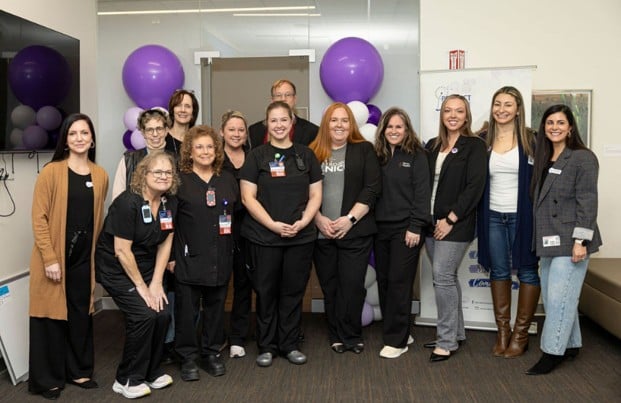
Pam Frasco knows firsthand how it feels to have a baby in a neonatal intensive care unit, or NICU.
Her first son, who recently turned 14, was born at 31 weeks’ gestation. Weighing only three pounds, he spent nearly seven weeks in the NICU so his body could continue to develop, grow and strengthen enough for a healthy transition to home. Her second son, now 11, spent more than a month in the NICU.
“I never wanted to leave the bedside. I didn’t know anybody. We weren’t encouraged to talk to other parents,” Frasco said. That experience is common, and as a result, parents often feel isolated while their baby is in the NICU.
That’s one of the reasons she founded Project NICU in 2018. Project NICU is a nonprofit dedicated to providing financial and emotional support resources to families with children in the NICU and NICU medical professionals.
That mission took root in December 2025, when Project NICU, in partnership with MetroHealth and The MetroHealth Foundation, launched its first Respite Room for parents in the NICU at MetroHealth.
The room provides a space where parents can relax, have a meal and to privately express their feelings – without being too far from their baby, said Frasco, who is also president of Cleveland-based Project NICU
“The NICU experience is traumatic. You are having tough conversations with doctors and sometimes you need a moment to gather yourself,” she added. “Having to walk the hospital halls to go to the cafeteria to have a cry can be really difficult.”
Meaghan Musarra, a MetroHealth NICU graduate parent and a Project NICU volunteer, said the Respite Room is the first of its kind for Project NICU.
As a NICU parent herself, Musarra’s middle child was born at 33 weeks and spent two weeks in the NICU working through feeding challenges and infection concerns.
After her NICU journey, Musarra discovered Project NICU through social media while looking for support. She joined Project NICU’s first class of ambassadors to give back to the MetroHealth NICU and has been involved ever since.
A few years later, she found herself in the NICU again briefly after her youngest experienced respiratory events at birth and required resuscitation several times. That experience reinforced for Musarra that there is no small NICU stay. NICU families experience a wide variety of lengths of stay in the hospital, but even a short time in the NICU is deserving of community and support, Musarra said.
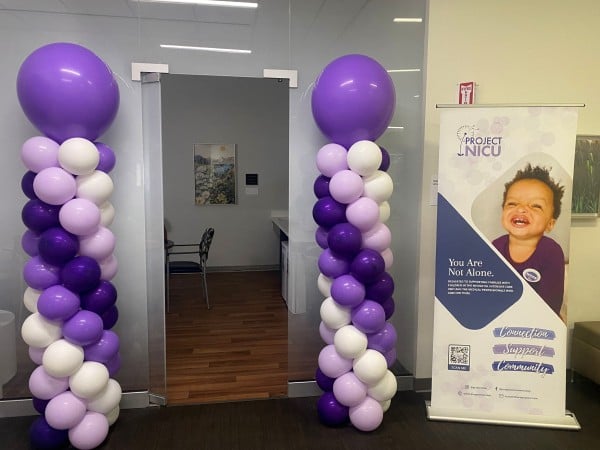 With that shared understanding, Musarra and Frasco championed the Project NICU partnership, making this Respite Room a reality.
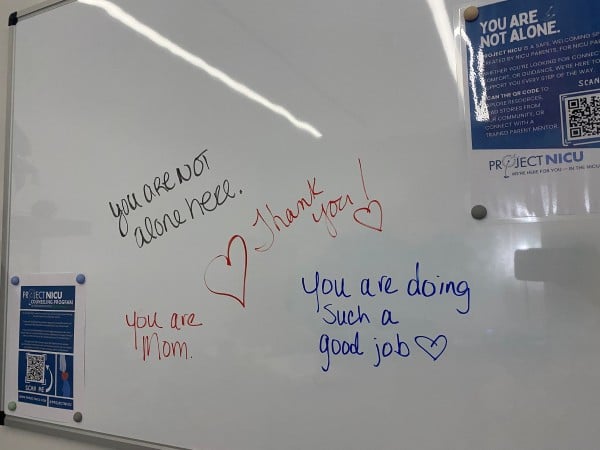
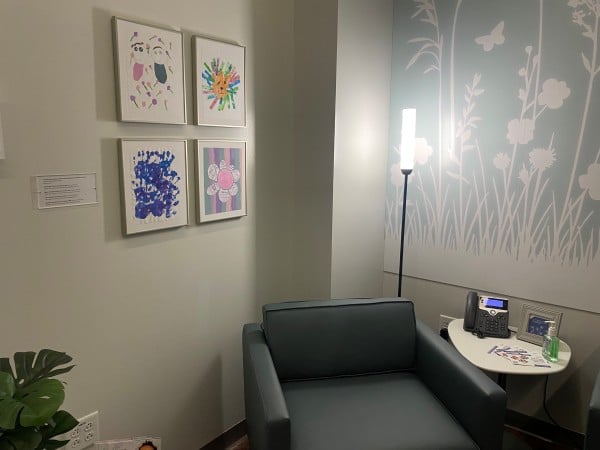
The room is a stark contrast to a NICU baby’s hospital room. As you enter the room, you are greeted by a dry-erase board where parents can share messages of hope and encouragement. Warm colors line the walls, and soft lighting casts over living room-style furniture, creating a peaceful spot where parents can quietly decompress, catch their breath and focus on their mental health. The room also includes a library for parents, a space for siblings, snacks provided by Project NICU and a refrigerator to store meals.
Parents can brew a fresh cup of coffee surrounded by artwork created by MetroHealth NICU graduates. Their artwork offers hope and a chance to see past the current NICU environment, Musarra said.
Though a living room-type space may seem like a small gesture, it carries a big impact because it offers hope, said Connie Eggleston, the nurse manager in the NICU at MetroHealth with 35 years of experience.
“All the things they thought their pregnancy and birth would be are now different,” she said. “The Respite Room is another way for parents to know that we really care about them. We’re here to support them and give them as much comfort as we can.”
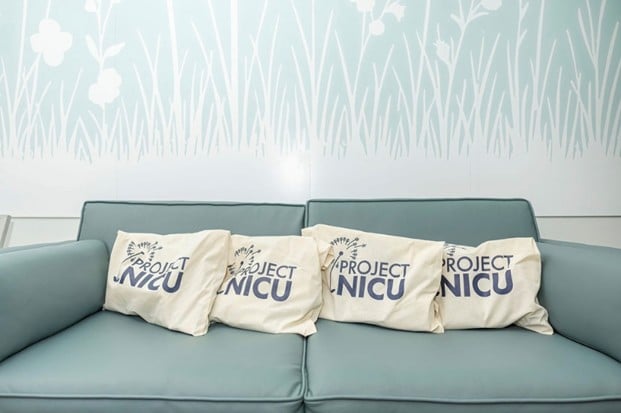
While MetroHealth’s new NICU has private rooms for each baby and their parents, it can still be helpful to step away from that room without having to go too far, Eggleston said.
“Even though the families have private rooms, the rooms are not quiet, or they can be too quiet,” Frasco said. “There is always a machine beeping, reminding you that you are in the hospital.”
The Respite Room has already had a positive impact.
“When we opened, a new NICU dad walked in with tears. He was so grateful for the opportunity to be away but also for the loving care he had seen from the nursing team,” Frasco said.
Parents are encouraged to write their thoughts in a public journal in the Respite Room. Frasco thought of the idea after receiving her own journal while her first son was in the NICU. Even if no one else read her innermost thoughts, the opportunity to write them down was an acknowledgment that another person understood, she said.
Grief and guilt are also part of the NICU experience, Musarra said. She grieved for missed moments, like her children meeting within the first few days and newborn snuggles. She carried guilt for having to spend time with one child and not the other.
“Those emotions feel huge when you are in the moment. When I am at MetroHealth supporting NICU parents, my biggest focus is to remind them they’re not alone, Musarra said. “I didn’t know anyone who had a NICU journey. I was the first in my friend group and family. I couldn’t relate to anyone, from milestones not being met to extra appointments and monitoring, and the risks of having a premature infant.”
Project NICU works directly with local hospitals to provide extra services parents need to cope, so they can focus on their baby’s health. The organization has about 60 active volunteers and is growing, Frasco said.
The Respite Room represents a collaboration among Project NICU, MetroHealth and The MetroHealth Foundation – all committed to supporting families during some of their most challenging moments. After all, anyone can have a baby in the NICU; preterm birth transcends socioeconomic boundaries and can happen even with excellent prenatal care, Frasco said.
“We were lucky with our care and the outcome, but there are many families who face more barriers than we did,” she said. “We love being able to walk alongside these families and help them feel acknowledged and supported. Any parent who finds themselves in the NICU should know that Project NICU is out there, and they are not alone.”
The MetroHealth NICU and Project NICU need ongoing support to continue providing for non-medical needs.
“We will accept new car seats, pack-and-plays and gift cards for meals or gas, Eggleston said. These items may be donated directly to the unit. She added that while the average NICU stay is two to three weeks, some babies remain in the unit for several months.
All cash gifts for the NICU can be directed through The MetroHealth Foundation at metrohealth.org/donate.
Fully funded by grants and community gifts, Project NICU also invites those interested in volunteering or supporting its mission to learn more about getting involved at ProjectNICU.com
Since its inception, Project NICU has reached more than 56,000 families through support groups, parent mentoring programs, social media outreach and educational webinars. Project NICU has provided free mental health services to nearly 700 NICU parents and medical professionals and distributed more than 13,000 care packages to families in the NICU.
For more information, please contact Abbie Sender, Philanthropy Officer, at the Office of Strategic Philanthropy, at 440-592-1390 and asender1@metrohealth.org.
Your Generosity Means a Healthier Greater Cleveland
Support MetroHealth in its commitment to care for all.