Champion of Philanthropy: Jessica Chupnick
Published on 05/05/2026
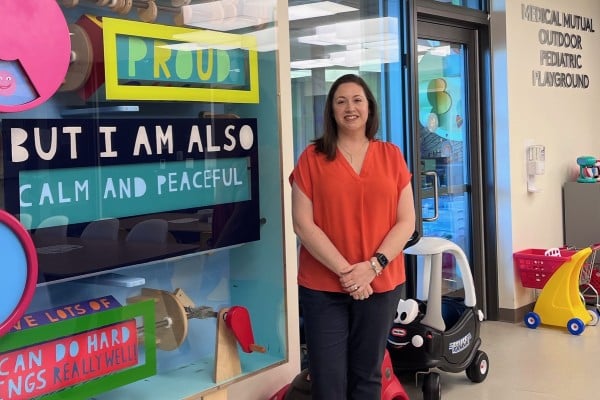
A child’s laughter can brighten even the grayest of days. Jessica Chupnick is one of the lucky ones; she gets to hear children giggling with excitement all the time, even though they may be facing what seem like insurmountable odds.
Jessica is the Manager of Child Life and Pediatric Programs at MetroHealth. She has been named a Champion of Philanthropy by the Office of Strategic Philanthropy, which honors colleagues who go above and beyond to support MetroHealth’s mission through advocacy, generosity and meaningful connections.
Her office is mere steps away from the inpatient children’s playroom in The Glick Center’s Pediatric Unit. “It’s funny to hear a kid excited in the hospital,” she said with a smile. “When a child is healthy enough to go to the playroom, I hear them skipping down the hallway.”
Child Life and Education launched in 1955 as the first university-affiliated program of its kind in the country. The team uses play to help children up to age 18 process and face the health issues they are experiencing, such as coping with an upcoming surgery of their own or learning about a new diagnosis in a developmentally appropriate way.
Though she has been at MetroHealth for more than a decade, Jessica’s introduction to child life programming began when she was a young girl facing surgery for a benign bone tumor. Two years later, she was diagnosed with Hodgkin’s lymphoma, needing multiple surgeries, chemotherapy and radiation therapy. Having grown up on Cleveland’s east side, she completed her high school senior project at MetroHealth with the Child Life and Education team, so she has always been drawn to the public health system.
Jessica is particularly proud of the playroom and the Pediatric Unit at The Glick Center. Stepping past her office, smiles and looks of wonder come across the faces of people as they peek inside the glass walls of the playroom.
The walls are adorned with colorful murals by local artists, and toys and books purchased with funding from donors line the room.
Whether a board game, a pinwheel or a doll-sized MRI machine, “Everything you see in this room was touched by a donor,” Jessica notes.
While the general public might see these items as toys – and they are – they are also powerful teaching and coping tools that enable children to face medical issues that can be hard for even adults to handle.

Jessica and members of the Child Life team.
The Child Life team helps children express themselves through play, Jessica said. For example, a six-foot-tall, see-through machine that stands up against one wall enables a child to turn gears and levers to express if they are sad or happy, or if they are having a good or bad day.
A child might choose to pretend to be a doctor or a nurse and play through the steps of their upcoming immunization or put a band-aid on a stuffed animal after pretending to check their blood. Some children may choose to release stress by squeezing a stress ball or taking deep breaths blowing into a pinwheel.
“We look at the family, the child and their previous healthcare experience through the lens of how they are coping and understanding their current experience,” she said. “While we are learning about how the patient and their family are coping, we’re also playing board games, doing crafts, playing video games and so much more together. By engaging in these familiar activities, we bring a sense of normalization to the healthcare environment.”
Jessica is happy to show off these tools, and she always makes time in her schedule to show existing and potential donors around the unit and the playroom, said Abbie Sender, a Philanthropy Officer at The MetroHealth Foundation.
“I glow when I talk about MetroHealth. I want to invite people in, show them the space, tell them about the work that we do,” Jessica added.
Jessica often walks people through the entire Pediatric Unit and shows them the modern technology that makes medical information easy for children and their families to understand. The single rooms have colorful, new blankets, pillowcases and stuffed animals to help make the rooms a little brighter and feel more like home, items that Jessica notes are also donated or funded by donors.
“Jessica walks guests through each play area and explains how everything was created to be part of a medical-free zone and how Child Life specialists assess children through play while putting them, and their caregivers, at ease,” Abbie said.
What really sets Jessica apart is that she is on the lookout for fundraising connections even when she isn’t working, Abbie said. The summer of 2025 presented one such opportunity when Jessica was shopping at the Kendra Scott jewelry store in Woodmere, where she began talking to the store manager about the company’s philanthropic interests.
“It was Jessica who shared that Kendra Scott stores nationwide aim to establish partnerships with local hospitals and their pediatric units,” Abbie said. “Without prompting, Jessica took it upon herself to work with the manager of the Eton Collection store to coordinate a fundraiser for our Child Life and Education Department last September. That event led to the new MetroHealth-Kendra Scott partnership for third-party lobby sales at The Glick Center.”
Jessica also manages to attend fundraising events for MetroHealth throughout the year, despite being the mother of two teenagers. She often provides a personal greeting and expresses her gratitude to fellow attendees during the event remarks, Abbie said.
“Jessica understands that creating relationships is paramount to philanthropy. It’s always a pleasure to work with her and watch her effortlessly speak with groups who support MetroHealth’s Pediatrics Department,” Abbie said. “From year to year, many remember her and call her out by name when she attends events that support Child Life. She’s more than a team player. She is a team member.”
While MetroHealth is fortunate to have someone so dedicated as Jessica, she notes that she is the one who is blessed.
“The patients and families are faced with so many things and they face it with resiliency and hope and trust in the team,” Jessica said. “There’s something very special about patients and families trusting us with their healthcare experience.”

Jessica and her family.
Support the Child Life Program
There are many ways to donate to the Child Life and Education program at MetroHealth.
While cash helps the program buy everything from educational toys to crafting items, in-kind donations and items from the program’s wish list are always welcome. Diversity in the items donated is necessary to tailor the team’s interactions with each child, Jessica said.
“We are big proponents of giving kids realistic choices because they don’t have a choice to be here or not or in what’s happening to them,” she said. “We ask them how they prefer to cope and what they enjoy playing with.”
Every donation matters, Jessica said, noting that she recently witnessed a child giving a stuffed animal a pretend dressing change with a child life specialist, using a stuffed animal dog provided by the Child Life team.
Another preschool-aged girl who was getting her blood drawn had interacted with a Child Life specialist and had the opportunity to choose what item she wanted to use to cope with her upcoming procedure. Among the donated items, such as a stress ball, pinwheel, fidget toy and bubbles, the patient chose to squeeze a stress ball. While squeezing, the little girl reassured herself by saying, “It’s gonna be okay.”
For more information, please contact Abbie Sender, Philanthropy Officer, at 440-592-1390 or asender1@metrohealth.org.
Your Generosity Means a Healthier Greater Cleveland
Support MetroHealth in its commitment to care for all.